
Like the Bee Gees, Fleetwood Mac, and a handful of other artists, the late Marianne Faithfull was lucky enough to have had more than one musical incarnation. The first began in 1964, when she scored a worldwide folk/pop hit with the lilting “As Tears Go By,” which was composed by her then-future boyfriend, Mick Jagger, and his songwriting partner, Keith Richards. She followed that up with several other memorable Top 40 tunes. But she also released “Sister Morphine,” a song she co-wrote with Jagger and Richards that suggests why her career went off the rails in the late sixties. When she returned in 1979, she debuted a raspy and radically different voice on an album called Broken English that led to a new period of fame.
It’s that second era in the spotlight that garners most of the critical praise, but Faithfull’s 1960s material also deserves plaudits. And it’s the subject of a recently released six-CD, 81-track anthology called Cast Your Fate to the Wind: The Complete UK Decca Recordings. The clamshell-boxed set presents remastered versions of Faithfull’s four albums for the label, plus 27 remastered singles, B-sides, and rarities. All these performances benefit from Faithfull’s delicate vibrato and complementary orchestrations. Other pluses include the excellence of the material and the extent to which she proves capable of handling everything from traditional and modern folk to Brill Building tunes and rock.
The package includes five “art cards” and a well-illustrated 76-page book with notes by Grammy-nominated producer Andrew Batt, who handled the remastering. His extensive essay, which incorporates many quotes from Faithfull, debunks the popular notion that she made few of the artistic decisions during this phase of her career.
Discs One and Two in the anthology feature her first couple of albums, which were issued simultaneously in April 1965, less than four months after the singer’s 18th birthday.
The folk-oriented Come My Way makes room for a few contemporary songs, such as Ian Tyson’s great “Four Strong Winds,” but consists mostly of traditional tunes, among them “House of the Rising Sun,” “Fare Thee Well,” and “Once I Had a Sweetheart.” Frequent Faithfull accompanist Jon Mark, who produced the set, arranged most of these numbers. (Yup, the same Jon Mark who played with John Mayall and enjoyed success in the Mark-Almond Band.)
The eponymous other album from April 1965 is more pop-flavored. It incorporates “As Tears Go By,” as well as Jackie DeShannon’s “Come and Stay with Me,” which produced a hit single for Faithfull, and covers of the Beatles’ “I’m a Loser” and “Downtown,” the Petula Clark hit.
North Country Maid, her 1966 third CD, features such numbers as the traditional “Scarborough Fair,” Tom Paxton’s “The Last Thing on My Mind,” and Donovan’s “Sunny Goodge Street.” Disc Four is devoted to 1967’s Loveinamist, whose standouts include “Young Girl Blues” and two other Donovan songs, Tim Hardin’s “Reason to Believe,” and John Lennon and Paul McCartney’s “Yesterday.”
The remaining two discs, which collect the singles, B-sides, and rarities, contain numerous highlights, including the 1965 hit “Summer Nights” (the original 45 as well as a rerecorded version) and “Go Away from My World,” another single from the same year, which Mark composed. Two readings of “Sister Morphine” and an alternative take of “Sunny Goodge Street” are here as well.
Note that “UK” follows the word “Complete” in the box’s title. In the 1960s, British acts’ UK and U.S. discographies differed, and Faithfull’s catalog was no exception. Three of the four studio LPs in this compendium appeared only in England and, though their contents largely mirror the American releases, completists might complain that one or two songs from Faithfull’s U.S. albums of the period are missing here. But all the hits are featured and a lot more, and one suspects most listeners will find that this box contains everything they need of her early work. Add A Perfect Stranger: The Island Anthology, which collects highlights from the 1980s and ’90s, and you’ll have an excellent picture of Faithfull’s entire career.
The box set is available on vinyl here and on CD here.
Also Noteworthy

Robin Batteau, Banned in Sparta. Singer, songwriter, producer, and multi-instrumentalist Robin Batteau returned to Harvard during the pandemic to finish his degree after a 50-year absence. While there, he wrote a thesis that led to this unusual and satisfying album, whose lyrics draw on the poetry of ancient Greeks.
“The Greek lyric poets performed live and were the stars of their day,” says the Grammy-winning Batteau. “They were singer/songwriters. They played the lyre [hence “lyric”] and danced around the stage like Tom Paxton and Taylor Swift.”
You might not be familiar with most of those Greek poets, who lived from the seventh to the fourth centuries B.C. However, you will likely recognize the names of some of the artists Batteau enlisted to sing lead on various tracks. Paxton is here, delivering a cheery number called “Thracian Filly.” So are veteran folkies such as Carolyn Hester, Eric Andersen, and James Taylor’s siblings, Kate and Livingston.
Surprisingly, none of these tracks sound a bit anachronistic. In fact, Andersen’s reading of “Cross (of Gold),” a song written more than two thousand years ago, could easily be mistaken for a recently penned original from the singer’s own catalog.
The album is available for download here.
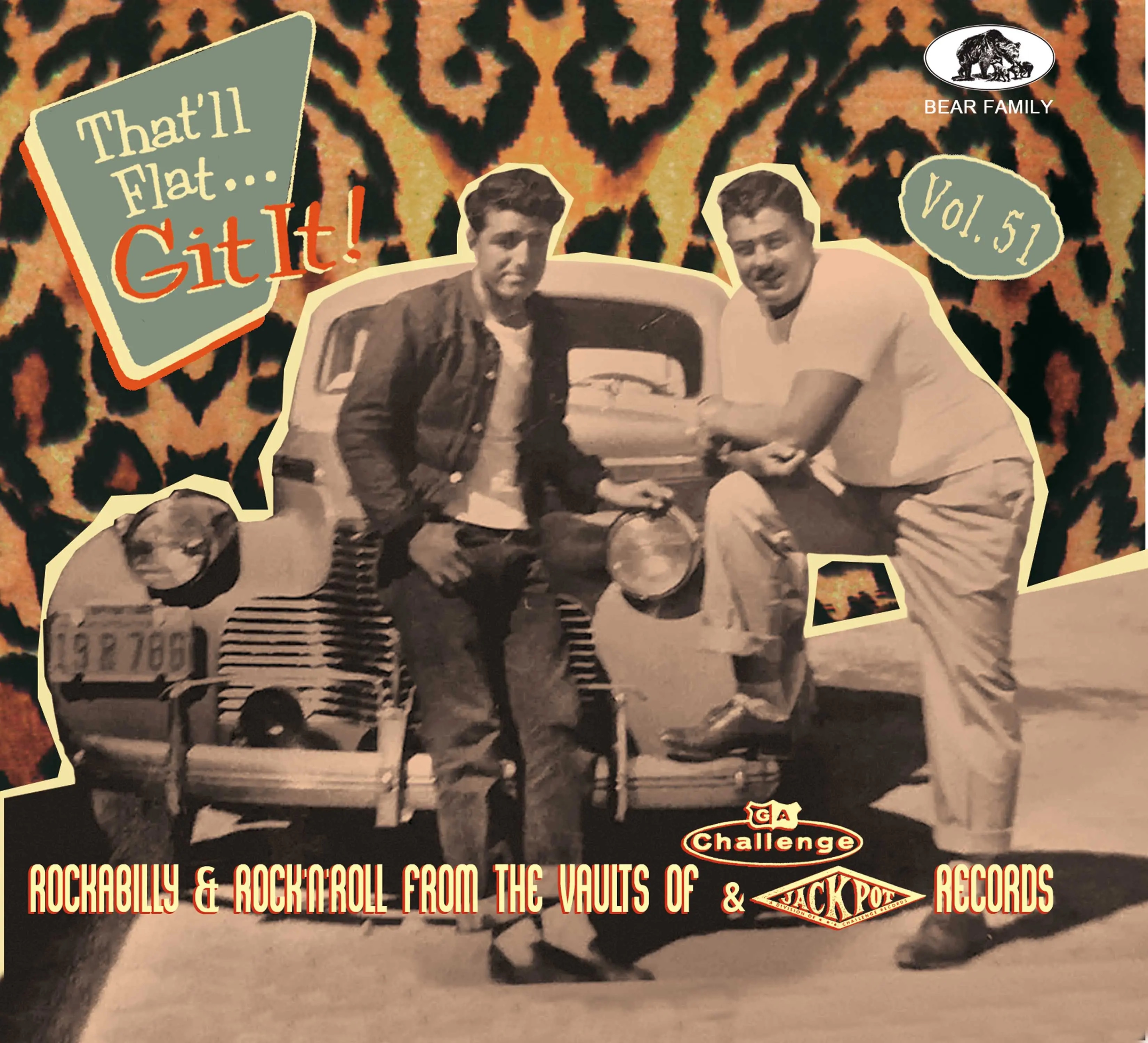
Various artists, That’ll Flat…Git It! Vol. 51: Rockabilly & Rock ‘n’ Roll from the Vaults of Challenge and Jackpot Records. This is the latest volume in a seemingly endless and endlessly fascinating series of anthologies devoted to early rockabilly and rock. The CD features remastered tracks from the long-defunct Challenge label, which film cowboy Gene Autry launched in 1957, and its Jackpot subsidiary.
Among the 36 numbers, all from 1957 through 1962: “Vampira,” a novelty rocker by future country star Bobby Bare; “Holy Mack’rel,” which offers a raucous tenor vocal by Prentice Moreland, a veteran of Billy Ward’s Dominoes who figured prominently in the Cadets’ 1956 hit, “Stranded in the Jungle”; and “So Tough,” a wild sax showcase by a Los Angeles–based R&B vocal group called the Kuf-Linx (not to be confused with the Cuff Linx, who recorded a more sedate version of the same song).
The Kuf-Linx number features backup by the Champs, who are featured here on an additional three numbers, including the sax-spiced “Maybelle,” which is named for Autry’s horse and sounds a bit reminiscent of the Everly Brothers. The program doesn’t embrace the Champs’ chart-topping “Tequila” instrumental, but it does include a lyrics-enhanced version, “Tequila Song,” that the group’s Danny Flores recorded with an outfit called the Contenders.
The album is available here.
Discover more from By Jeff Burger
Subscribe to get the latest posts sent to your email.
 By Jeff Burger