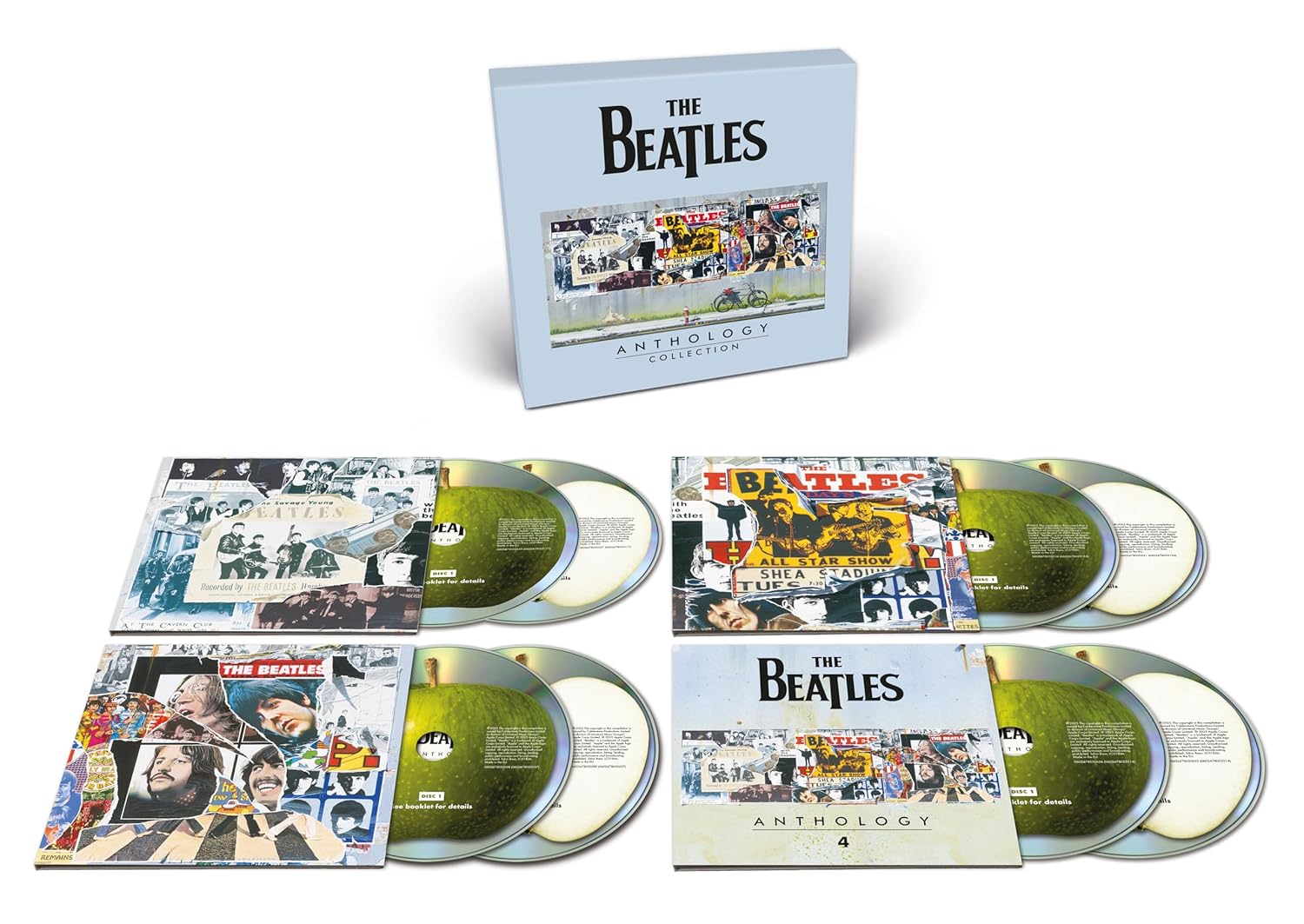
How on earth did the Beatles progress from songs like “I Want to Hold Your Hand” to “Strawberry Fields Forever” and “Penny Lane” in only a little more than three years? The sparks that ignite artistic growth can be enigmatic, but the Fab Four’s Anthology album series, released in the mid-1990s, did help flesh out their story. Featuring a total of 155 previously unreleased tracks on three two-CD sets, it provided new insights into the group’s creative process via demos, alternate takes, outtakes, and audition, rehearsal, and live performances.
Three decades later, the band’s surviving members and their label have freshened up and expanded the series. The new Anthology Collection includes versions of the original three sets that have been remastered by producer George Martin’s son, Giles, who in recent years has overseen the development of box sets devoted to five of the Beatles’ most beloved LPs. In addition, the new release introduces a fourth two-CD set, also curated by Giles.
The first three sets come with the 48-page booklets that accompanied the original Anthology collections. They each include photos and notes by Beatles expert Mark Lewisohn. Anthology 4 features a similar 48-page booklet, but the notes for this one are by British producer Kevin Howlett. (Lewisohn, who is working on the second volume of his gargantuan, incredibly detailed Beatles history, was presumably too busy to contribute.) You’ll also find lots of discographic information in the booklets, and you should rely on them for song credits, because the discs’ metadata is riddled with inaccuracies.
If you’re a Beatles fan (and who isn’t?) and don’t already own the first three compendiums, the Anthology Collection should prove irresistible. If you have volumes one, two, and three, however, the new set’s remasters, while offering significant sonic improvements, probably don’t provide enough justification to upgrade. So, you’ll be glad to know that, while the initial plan was to offer Anthology 4 only in a package with its three predecessors, Apple Records yielded to fan pressure and has made it available separately.
We’ll talk presently about that fourth set, but first, for those who don’t own the earlier volumes, let’s look at what they offer.
Anthology 1 opens with what at the time of its release was something new: “Free as a Bird,” a likable single that the surviving Beatles built in 1994 on the foundation of a 1977 John Lennon demo. After that, the set turns the clock way back to 1958 to open a window on the Fab Four’s creation. We hear a cover of Buddy Holly’s “That’ll Be the Day” and “In Spite of All the Danger,” a Lennon/George Harrison composition, both performed by the Quarrymen, the group that evolved into the Beatles. Here, too, are several tracks that feature original bassist Stu Sutcliffe or drummer Pete Best, recordings from the Beatles’ 1961 stint in Hamburg, Germany, and five numbers from the group’s unsuccessful Decca audition. Also featured are 17 live performances from 1963 and 1964, and alternate takes of such early originals as “Eight Days a Week,” “No Reply,” and “A Hard Day’s Night.”
Like its predecessor, Anthology 2 opens with a newly created track, “Real Love,” which consists of a 1980 Lennon recording with 1995 embellishments by his surviving bandmates. After that, the set picks up where Anthology 1 leaves off, delivering demos, outtakes, and alternate versions of songs that show the group growing creatively at a breakneck pace. These numbers come from the sessions for Help!, Rubber Soul, Yellow Submarine, Revolver, Sgt. Pepper’s Lonely Hearts Club Band, and Magical Mystery Tour, and include versions of classics such as “Yesterday,” “Eleanor Rigby,” “Strawberry Fields Forever,” “Penny Lane,” and “The Fool on the Hill.” There are also a few live tracks, among them “Everybody’s Trying to Be My Baby,” from the Beatles’ famous 1965 show at New York’s Shea Stadium.
Anthology 3, which draws its program almost entirely from 1968 and 1969, predominantly features home demos and alternate takes of songs from Abbey Road, Let It Be, and the eponymous double LP widely known as The White Album. There are also a few originals that the Beatles had not previously released, such as “Step Inside Love,” which Cilla Black once recorded, and “What’s the New Mary Jane,” as well as covers of songs such as “Blue Suede Shoes” and “Ain’t She Sweet.” Another attraction is a demo version of the song that would become the title track on George Harrison’s All Things Must Pass.
A remix of “The End,” the last full-length track on Abbey Road, concludes the album. Until now, it also concluded the Anthology series, but as noted above, a fourth package has just been released. Unlike the first three volumes, which respectively cover the Beatles’ early, middle, and later years, Anthology 4 includes material from their entire career.
This 44-track compilation is a bit of a disappointment compared with its three predecessors, partly because it contains only 13 previously unreleased tracks, even though more remain in the vaults. Dominating the program are recordings culled from expanded editions of Revolver, Sgt. Pepper’s, The Beatles, Abbey Road, and Let It Be, as well as new mixes by Jeff Lynne of “Free as a Bird” and “Real Love.” All this material is worth hearing, however, so, especially if you don’t have those excellent but pricey earlier boxes, you might well want to pick up Anthology 4.
That said, let’s hope that Giles Martin and his associates will now turn their attention to something with the potential to be more revelatory than this fourth Anthology volume. One suspects, for example, that more than a few Beatles fans are eagerly awaiting a box set devoted to the sessions for Rubber Soul.
The collection is available on vinyl here and on CD here.
Also Noteworthy

Warren Zevon, Epilogue: Live At The Edmonton Folk Music Festival. This Canadian concert, recorded about 13 months before Warren Zevon’s death in September 2003, proved to be his last. Unlike 1980’s Stand in the Fire, his first live LP, it does not feature a full band—just the singer on guitar, piano, and harmonica, and longtime accompanist Matt Cartsonis on various instruments. And unlike 1993’s Learning to Flinch, Zevon’s second live LP, which is a solo effort, it was recorded at a single show. As such, it feels more cohesive than its predecessor.
The 51-minute concert features a few of the deservedly well-known Zevon numbers that also pepper the earlier sets, including “Lawyers, Guns and Money,” “Werewolves of London,” and “Poor Poor Pitiful Me.” But there are some deep cuts here, too, including “Dirty Life and Times,” which would show up on the posthumous The Wind, and three songs that reflect the show’s Canadian venue: “Hit Somebody! (The Hockey Song),” the traditional “Canadee-I-O,” and an affecting cover of “A Case of You,” by Joni Mitchell, who was born a few hundred miles south of Edmonton.
Everything here reinforces the impression that when we lost Warren Zevon, we lost a lot.
The album is available on vinyl here and on CD here.

Rahsaan Roland Kirk, Vibrations in the Village: Live at the Village Gate and Seek & Listen: Live at the Penthouse. These previously unreleased recordings capture jazz great Roland Kirk in concert in 1963 at New York’s Village Gate and in 1967 at Seattle’s Penthouse club. Both sets have undergone sound restoration and are accompanied by copious liner notes, and both evidence Kirik’s playfulness, inventiveness, and versatility.
Self-penned material dominates the New York show, which also incorporates Charles Mingus’s “Ecclusiastics” and several numbers from the Great American Songbook, among them Richard Rodgers and Lorenz Hart’s “Falling in Love with Love” and Oscar Hammerstein II and Jerome Kern’s “All the Things You Are.” As usual, Kirk plays multiple instruments, including tenor, soprano, and alto saxes and flute. His accompanists include bassist Henry Grimes and drummer Sonny Brown, as well as pianists Horace Parlan (four tracks), Melvin Rhyne (three tracks), and Jane Getz (two tracks).
The Penthouse album, a two-CD set, augments numerous originals with several covers, including Duke Ellington’s “Prelude to a Kiss” and a 12-minute take on Bobbie Gentry’s “Ode to Billie Joe.” Kirk again plays tenor, soprano, and alto sax, and several other instruments. Accompanists include pianist Rahn Burton, bassist Steve Novosel, and drummer Jimmy Hopps.
Vibrations in the Village is available on vinyl here and on CD here. Seek & Listen is available on vinyl here and on CD here.
Discover more from By Jeff Burger
Subscribe to get the latest posts sent to your email.
 By Jeff Burger
But, Jeff- Didn’t The Beatles break up or something?
LikeLike
Yeah, I think I heard something about that.
But, seriously, it’s been more than half a century and they’re still selling more records than many new groups. I don’t see that changing anytime soon.
LikeLiked by 1 person
I hope the Armageddon reissue post & the comments re Yardbirds’ related Titles in their own family tree: Louis Cennamo’s Autobiography ‘Awake In The Dream’ as well as the LP (above – Armageddon 50th Anniversary rerelease by DEKO Entertainment ‘Pete M’ wasn’t lost when I put a lot of time in the statement & tapped on Submit (or something like that). Please let me know I wasn’t wasting my time & use of Words. Dave Dillon be9revolution@gmail.com
LikeLike