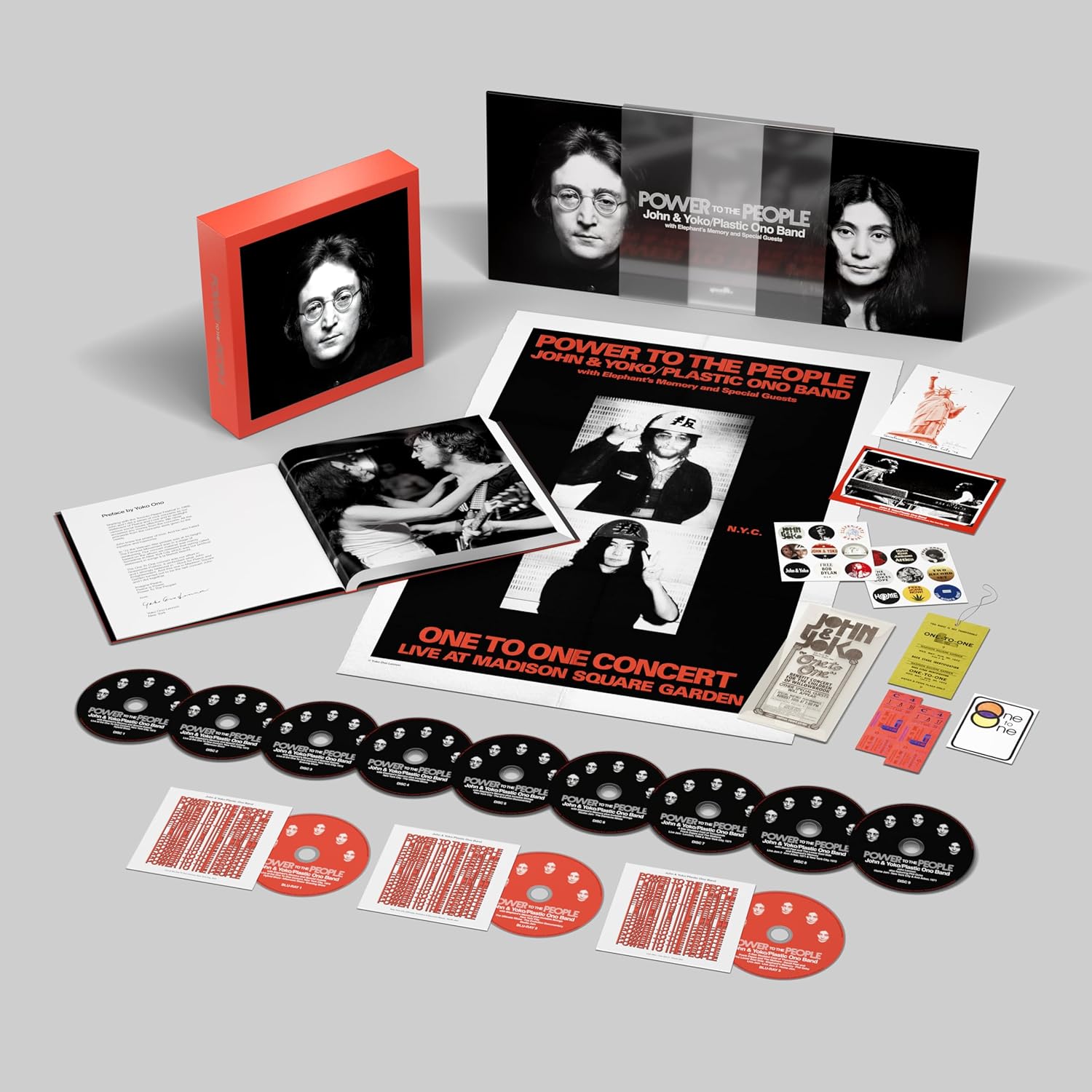
A large and lavish box set devoted to one of John Lennon’s least favorably reviewed periods might seem ill-advised, and in some ways it is. But Lennon lovers will find interesting material in the new Power to the People, and even casual fans will discover some pleasures here.
The collection, which Sean Ono Lennon produced, is beautifully packaged with a cover that merges John and Yoko Ono’s faces and shows one or the other of them, depending on your viewing angle. It comes with an absorbing, copiously illustrated 204-page hardcover book, plus two postcards, two sticker sheets, and replicas of concert tickets, a show poster, and backstage and after-show passes. It includes nine CDs as well as three Blu-rays that deliver the music in hi-def stereo, 5.1 surround, and Dolby Atmos formats.
The box has two related centerpieces. One is material from Lennon and Ono’s Some Time in New York City LP, which arrived in stores on June 12, 1972. The other is the two sold-out “One to One” benefit shows for children with disabilities that the couple performed at Madison Square Garden about two and a half months later. The August 30 events—Lennon’s only full-length post-Beatles concerts—featured backup by the Plastic Ono Band and Elephant’s Memory and embraced many of the songs from the album.
Like Bob Dylan, who followed a long series of classic LPs with the disappointing mishmash of Self-Portrait, Lennon took a big fall with Some Time in New York. Nothing on the record was nearly as strong musically as his work with the Beatles or his prior solo albums, and his attempts at political songwriting, while clearly heartfelt, suggest that this was not his forte. Even the nonpolitical stuff—such as “Scumbag,” a collaboration with Frank Zappa that repeats the title ad nauseam—is subpar. As for Ono, she has lately been reassessed and pronounced ahead of her time by some critics, but it seems unlikely that she could have attracted much attention for her contributions here if Lennon weren’t also on the program.
Happily, the One to One shows include likable readings of some better material, such as Lennon’s “Imagine,” “Instant Karma (We All Shine On),” and “Mother,” and the Beatles’ “Come Together.” However, it was arguably unnecessary to include both concerts in Power to the People, given that their setlists and performances are nearly identical. And with those shows filling a pair of discs, did we really need a third with a “hybrid” concert consisting of the best performance of each song from the other two CDs?
Also overblown are the five discs related to Some Time in New York City. They include a “reimagined” version of the LP with “ultimate” mixes as well as early renditions and alternate mixes of songs from the album, none of which can compensate for the weakness of the material. (Curiously, the “reimagined” version of the record omits its original lead-off number, “Woman Is the Nigger of the World,” one of its better tracks.)
More notable are previously unreleased live jams from the Some Time in New York City sessions. They feature Elephant’s Memory, augmented by a star-studded guest list that includes George Harrison, Eric Clapton, Frank Zappa, Keith Moon, Nicky Hopkins, and Klaus Voormann. The group offers spirited readings of such rock and roll oldies as Carl Perkins’s “Honey, Don’t!” Chuck Berry’s “Roll Over, Beethoven,” and Fats Domino’s “Ain’t That a Shame.”
Perhaps most interesting of all is a 33-track disc of previously unissued 1971 acoustic solo home recordings by Lennon. Some of these are just snippets, but you’ll likely find it fascinating to be a fly on the wall as he strums his guitar and sings numbers associated with such artists as the Everly Brothers (“Wake Up, Little Susie”) and Buddy Holly (“Peggy Sue,” “Heartbeat,” “Maybe Baby,” “Rave On,” “Peggy Sue Got Married,” and “You’re So Square (Baby I Don’t Care).”
Also on this CD are performances by Lennon and Phil Ochs of the latter’s “I Ain’t Marching Anymore,” “Joe Hill,” “Chords of Fame,” and “Ringing of Revolution,” which make Lennon’s political tunes pale by comparison. It would have been interesting to hear these as vocal duets, but Ochs does all the singing, with Lennon just adding guitar.
You may be wondering why a box this big doesn’t make room for a film of the One to One concerts. That’s reportedly in the works and due to be released next year. But it would have made sense to include it here, perhaps in place of the duplicative disc that offers a “hybrid” version of the shows.
The box set is available here.
Also Noteworthy
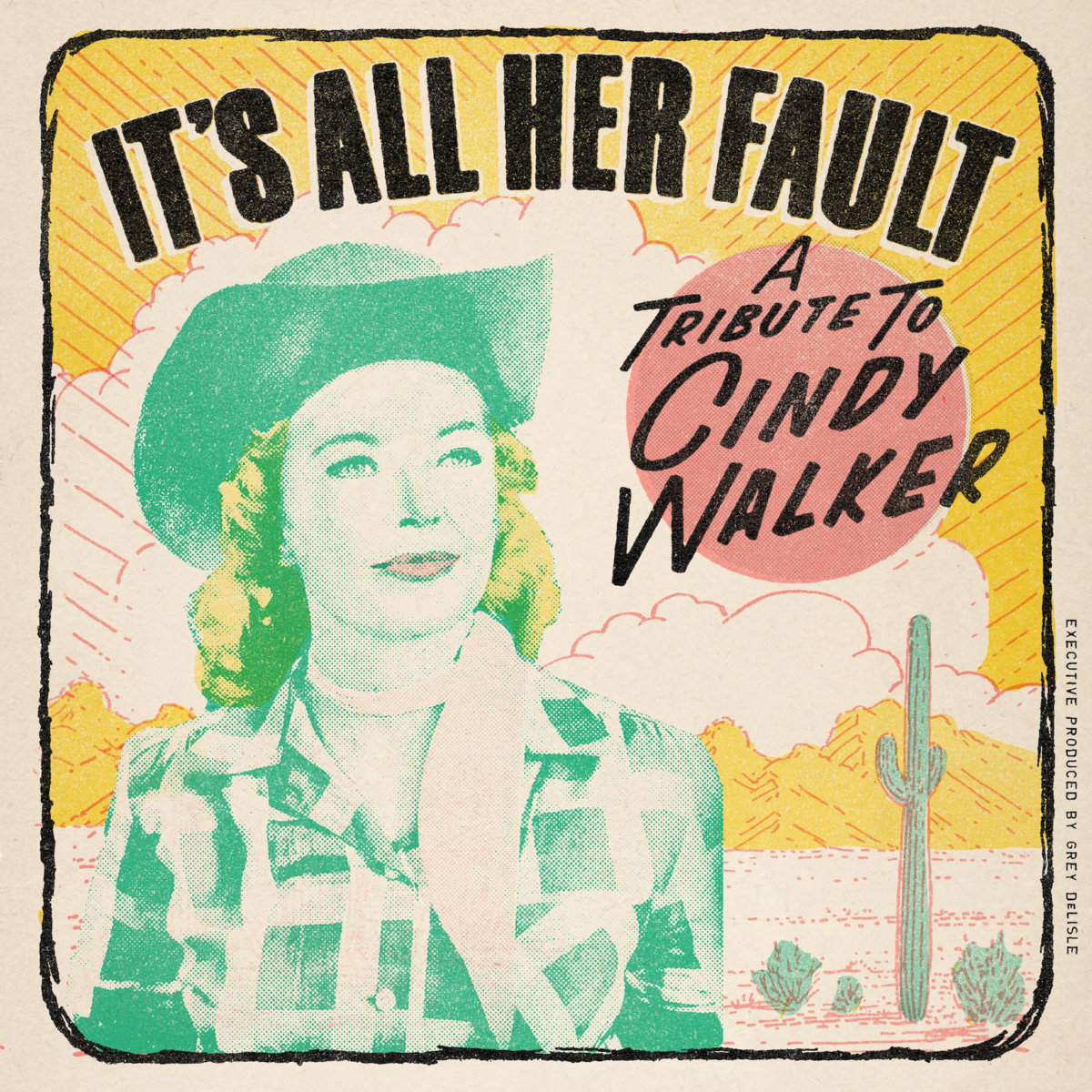
Various artists, It’s All Her Fault: A Tribute to Cindy Walker. Songwriters don’t always become as famous as their songs. The late Texan Cindy Walker is a case in point. Though she’s a household name among veteran country performers, many music fans have probably never heard of her.
You know her beautifully crafted songs, however. Walker wrote such numbers as “Dream Baby (How Long Must I Dream),” the Roy Orbison classic, which rose to No. 4 on the charts in 1962; the often-covered “You Don’t Know Me,” which she composed with Eddy Arnold and which gave Ray Charles a No. 2 hit the same year; and 1944’s “You’re from Texas,” one of many chart tunes she penned for country-swing king Bob Wills.
You’ll find covers of all those numbers on this fine tribute album, whose all-female lineup includes Kelly Willis (“I Don’t Care”), Summer Dean (“Don’t Talk to Me about Men”), Melissa Carper (“Take Me in Your Arms”), Jolie Holland (“Don’t Be Ashamed of Your Age”), and nine other artists.
The album is available here.
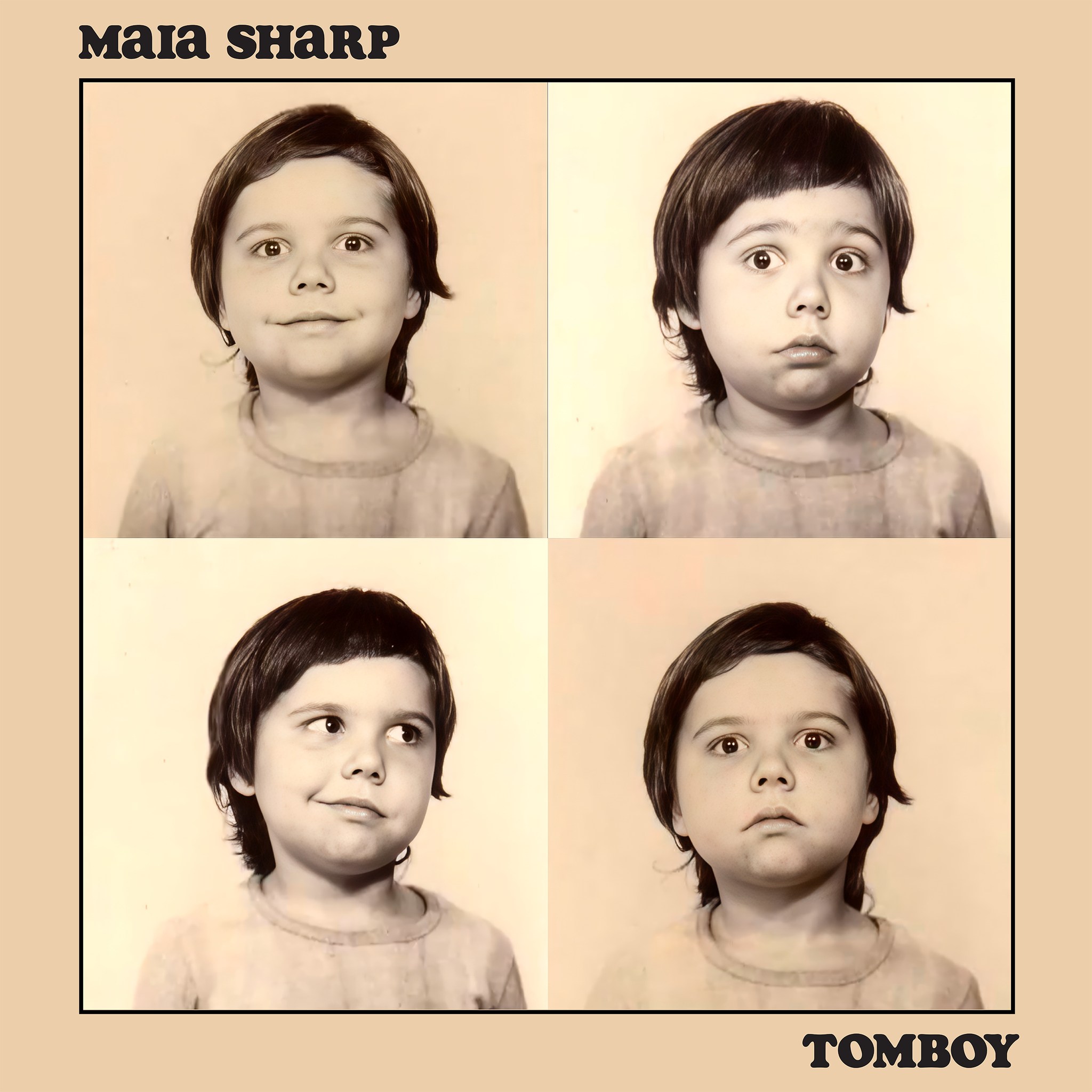
Maia Sharp, Tomboy. On Maia Sharp’s 10th album, her first since 2023’s Reckless Thoughts, the Nashville-based singer continues to display the songwriting prowess that has led such artists as Bonnie Raitt, Trisha Yearwood, and Cher to record her material. This self-produced album also suggests that the silky-voiced multi-instrumentalist is her own best interpreter.
The introspective, frequently moody set, which might at times remind you of Carly Simon’s work, includes nine new originals. Sharp composed seven of them with co-writers, several of whom sing along on their numbers. There’s also a cover of U2’s “I Still Haven’t Found What I’m Looking For.” Most of these songs are first-person tales—the first word in six of them is “I” or “I’m”—which adds to the sense that Sharp’s confessional lyrics draw heavily on her own life.
The album is available here.
The Cowsills, The “Cocaine Drain” Album (Deluxe Edition). Like the Cowsills’ Global, a 1998 album that reappeared in an expanded version in 2024, this deluxe edition of a 1978 LP sounds reminiscent of contemporaneous Fleetwood Mac recordings. Like that group, the Cowsills frequently feature a female lead vocalist and offer upbeat pop-rockers about romantic relationships. Most of the material is original, though the program includes a few covers, such as the title cut, which is by Orleans’s John Hall, and “I Will Always,” by Wendy Waldman.
The Chuck Plotkin–produced set, which features five bonus tracks, does incorporate some filler, such as the plodding “Part of Me.” Moreover, nothing here is as impressive as Fleetwood Mac’s mid-1970s standouts. That said, this album offers enough lilting, well-sung material to convince you that the Cowsills have much more to offer than their early bubblegum hits.
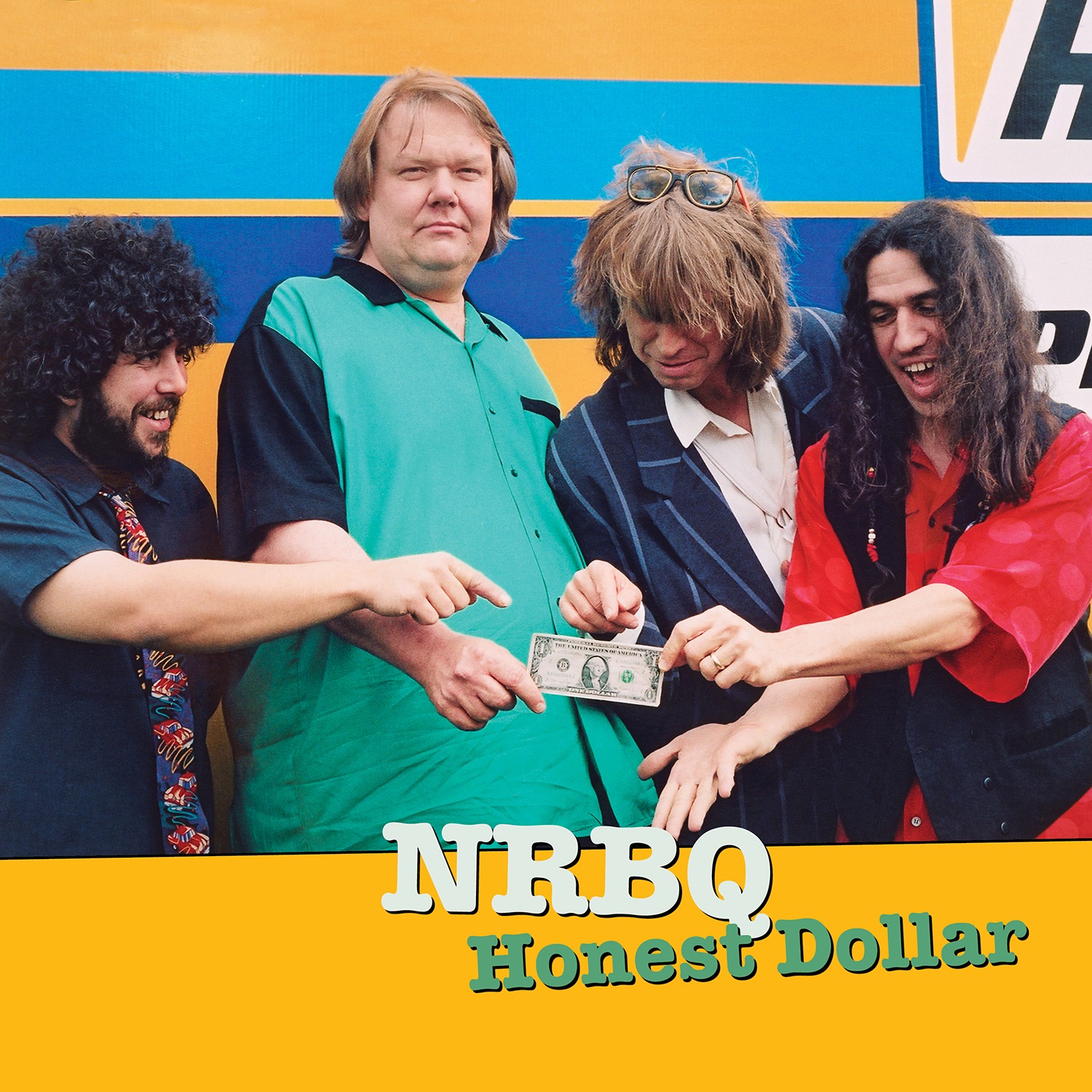
NRBQ, Honest Dollar. As this column has noted previously, it’s good that this outfit goes by its initials rather than what they stand for: New Rhythm and Blues Quartet (or Quintet, until 1978). The full name would be highly misleading, since R&B is just one element in a mix that also embraces garage rock, pop, rockabilly, blues, jazz, and more.
You can hear all those elements in this reissued 1992 live set, which includes two bonus cuts. Recorded between 1981 and 1991 at more than a dozen U.S. venues, the album’s 19 remastered tracks include a few of the band’s best-loved numbers, plus an eclectic menu of well-executed covers.
Among them are such early rock hits as Little Richard’s “Lucille,” Doc Pomus and Mort Shuman’s “Turn Me Loose,” which Fabian rode up the charts, and Len Barry’s “1-2-3.” Also here are a playful reading of Duke Ellington’s “Rockin’ in Rhythm” and a sweet take on the Lovin’ Spoonful’s “Amy’s Theme” that features harmonica by its composer, Spoonful leader John Sebastian.
The album is available here.
On the Bookshelf
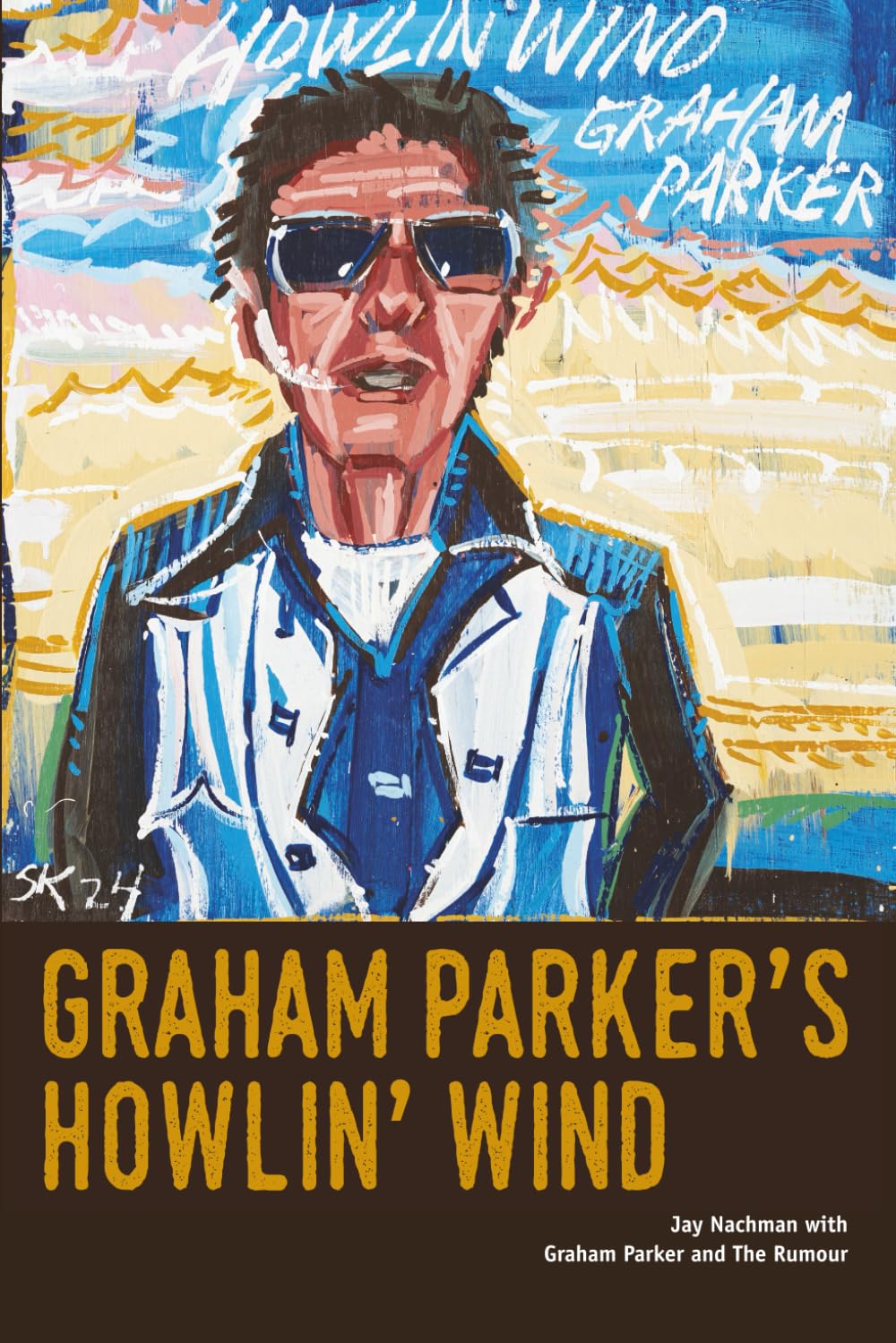
Graham Parker’s Howlin’ Wind, by Jay Nachman with Graham Parker and the Rumour. This book is no dispassionate journalistic exercise. In his introduction, author Jay Nachman declares himself a “Graham Parker fan for life” and describes the British rocker’s debut album, Howlin’ Wind, as nothing short of “momentous” in his own life. If you share his enthusiasm—or are simply curious about what makes Parker a cult figure—you’ll enjoy this book.
Nachman uses the LP named in its title as a jumping-off point for a discussion of Parker’s entire career. Drawing on his in-depth interviews with the singer, his bandmates, and many others in his orbit, Nachman chronicles Parker’s childhood and describes how his musical career began. He also discusses the singer’s eclectic influences, some of which might surprise you. (He’s a fan of the Incredible String Band, for example.)
The book ends with a chapter that includes lyrics for all the songs on Howlin’ Wind, along with detailed commentary on each of its numbers.
The book is available here.
Discover more from By Jeff Burger
Subscribe to get the latest posts sent to your email.
 By Jeff Burger