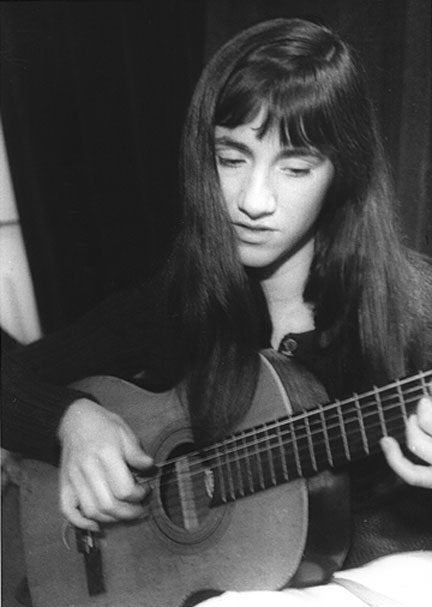
You really get your pence’s worth on the underground, London’s equivalent of America’s subways. Riders here pay less and receive more efficient service than their U.S. counterparts. And live music echoes through many of the tunnels that lead from ticket windows to train platforms.
The underground performers, known along with their street-singing kindred as buskers, include amateurs and professionals, soloists and groups, guitarists and fiddlers, flutists and bongo players. Some probably will be gigging in the tubes indefinitely, unless they decide to do the world a favor and give up music. However, many others display considerable talent and seem ripe for discovery.
Alisha Sufit, a six-year veteran of busking, fits the latter category. She is an accomplished singer/songwriter and an adept guitarist who has already recorded an album with the psychedelic folk group Magic Carpet. And her underground performances almost always draw an enthusiastic crowd.
Inspired by Eastern European and American folk and by Egyptian pop vocalist Fairuz, Sufit first took up guitar in early 1967. About a year later, she began singing in public. “Actually, I did street singing before I played in the underground,” she recalls. “Somebody had said I should go to Portobello Road and try singing there. So, I did, with the help of two friends who walked backward and forward incognito, putting money in my hat. And I bombed.”
This initial failure might have had as much to do with the profession’s then-shady reputation as with Sufit’s inexperience. “When I began,” she states, “busking was still on a level with begging, and the performers were looked down upon. Also, it was very, very unusual back then to see a girl doing it who wasn’t a tramp. It was still a tramp occupation.”
Now as then, busking is illegal, but Sufit has been fortunate in having been stopped by the police only three times in half a dozen years and, in each instance, the fine was only a pound or two. Today, she says, police are more apt to give her a coin than to arrest her, perhaps because the public now looks favorably on what she does.
“The status of busking has been upgraded a good bit,” notes Sufit. “People like the entertainment. A lot of excellent out-of-work musicians now try their hands at busking. You see quite a few talented fiddlers and folk musicians in the underground.
“There are some panhandlers as well, but I don’t like to do that. I mean, people can give me money if they want to. They do, and of course, it’s a help. But I really like to put the music first. I use it as a practice, and I sing the best I can.
“It’s a very, very free situation. You know that your audience really wants to be there, because they’re completely able to walk away the moment they get bored. If you’re singing badly, you often don’t get any crowd. But as soon as you’ve got some sort of inspiration and feeling coming out, people may stay through perhaps half a dozen songs. It’s a magical sort of thing, and it attracts me for that reason.”
Travelers on the underground seem to like Sufit’s music as much as she enjoys playing it for them. Though she also earns money from club and restaurant performances, a large portion of her income over the past six years has been dropped into her guitar case by appreciative passersby. “I’ve gotten 50p coins [about $1.20 U.S.] and pound notes [$2.40],” she remarks. “And people give me all kinds of nice things besides money. I’ve been given a necklace, bananas, and apples, a beautiful handkerchief, and a silver snuff box.”

Sometimes listeners even offer Sufit stardom. “I’ve had lots of people say, you know, ‘Together we can borrow huge sums of money and make you a big name.’ I’ve gotten all sorts of odd proposals. Like somebody from ESP Records talked to me a while back about doing an album. A weird company—they had Charles Manson recording for them.”
Sufit accepted one album deal several years ago, but nothing much came of the LP she recorded with the psychedelic folk band Magic Carpet. “It was on the Mushroom label,” she recalls with a laugh. “And true to its name, the company just disappeared overnight. Poof! Gone. I think there are still about 1,300 copies of the album in an office somewhere.
“If a recording possibility came up again, I’d want people who could help me musically and who could capably handle the business side of it because, after all, there’s no point in making a record that doesn’t sell.”
Hoping to find a contract that meets these requirements in America, Sufit recently traded her savings for an airplane ticket. “I’ve been to the States before,” she says, “and there just seems to be more happening there musically and more money to back it up.
“I’ll be glad if things work out there, but I’ll miss singing in the underground. There’s a special feeling to busking that you can’t get in clubs or anywhere else. You have the chance to attract so many different sorts of listeners, and you feel good every time someone likes what he hears enough to stop for a while.
“Also, in those tunnels, the sound quality is just fantastic!”
Discover more from By Jeff Burger
Subscribe to get the latest posts sent to your email.
 By Jeff Burger
