Forty-foot-high walls and observation towers manned by armed guards surround a fortress-like mass of steel and concrete. In front of the hulking bastion, a large sign announces what we already know: we have arrived at Pennsylvania’s Graterford Prison. After entering a small reception room, we sit on a hard wooden bench and wait with other visitors to be admitted. The barked orders of prison officials echo through a thickly barred iron gate; beyond it, we can see another gate and still another.
Somewhere in that seemingly impenetrable maze are the five prisoners we’ve come to meet. They are members of an R&B band called the Power of Attorney, which also includes four Graterford parolees.
My companion, photographer Harry Sandler, and I can hardly imagine what the meeting or, for that matter, the interior of the prison will be like. Our few impressions of large penitentiaries were drawn from the media. Neither of us has ever previously been within shouting distance of a maximum security cellblock or a man imprisoned for life. And never before have we been confronted with a sign like the one we are now reading:
VISITORS!
STOP—READ THIS NOTICE!
THE PASSING OR GIVING SUCH ITEMS OR ARTICLES AS
- Weapons, Drugs, Money
- Cigarettes, Chewing Gum, Paper
- Watches, Rings, Etc.
TO THE PERSON YOU ARE VISITING OR OTHER RESIDENTS CAN MEAN YOUR BEING HELD AND REPORTED TO THE STATE POLICE FOR IMMEDIATE CRIMINAL ACTION. ANY QUESTIONS REGARDING THIS NOTICE, ASK TO SEE THE OFFICER ON DUTY
I do have a question: How can someone be arrested for giving an inmate a piece of chewing gum? But before I can ask the “officer on duty” about this, he ushers us through the front gate.
Stamping our hands with an invisible ink marker, he instructs us to sign a visitors’ book. We are then admitted past a second gate, which clangs shut behind us with a heavy noise, and we enter a long hallway, where we are met by Ralph Pearcy, the prison’s activities director.
With Pearcy and his keychain as our passports, we continue through four more gates and doors, up and down three dimly lit stairways, and, finally, into a small, dusty room where the five from Power of Attorney are waiting for us.
As they begin to tell us about their band and what it means to them, its relation to their zoo-like environment becomes clear. To the members of Power of Attorney at Grateford, music is more than a vocation or simple pleasure. It represents a world of their own creation, a private reality. And it allows them, at least in spirit, to legally escape from prison.
Apart from their music, the five Power of Attorney members still at Graterford are F-1727, F-2506, H-9598, H-7723, and H-6137. They wear dull grey convict uniforms, identical in every respect except for the identifying numbers on the shirt pockets. Each of them lives in one of the prison’s five 400-man cellblocks. The tiny, impersonal cubicles they are forced to call home contain toilets, sinks, beds, footlockers, and blankets, along with whatever few possessions the residents have managed to accumulate and been allowed to keep. Like all Graterford inmates, they are required to work during the week; their weekends offer “free time,” which most of the prisoners look forward to.
“I guess we’re different about that,” says Power of Attorney bass player Charles McDowall, “’cause our work is our music and we’re not allowed to practice on weekends. You know, we can go to a movie, lie around the block, write some letters, but we can’t get to our rehearsal room. So usually, we’re glad when Monday comes, so we can go back to the business of the band.”
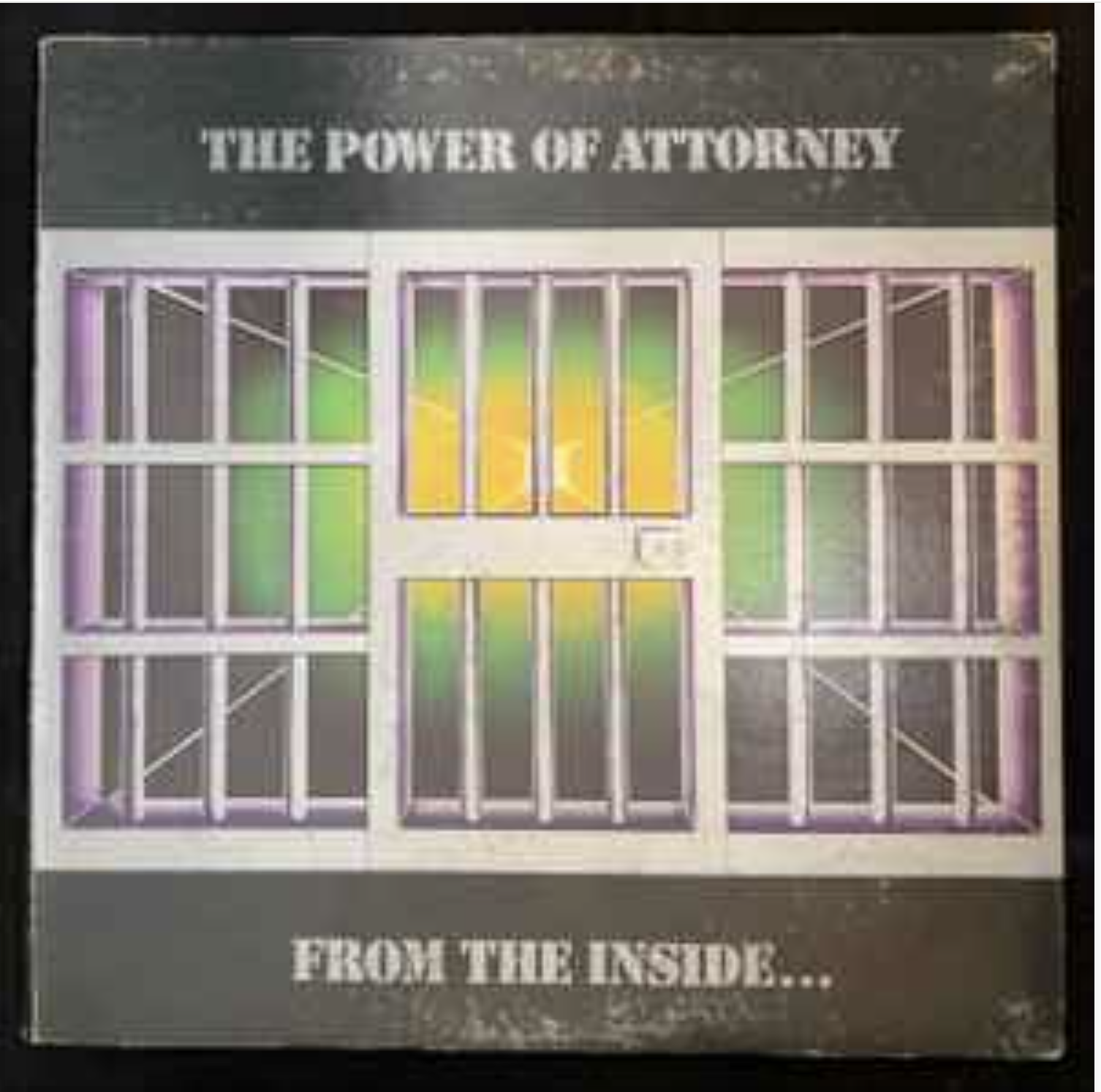
That business began about two years ago, when Power of Attorney was formed with the cooperation of the prison’s activities department. With special permissions and armed escorts, the band started to travel, first to colleges and clubs for gigs and then to a New York recording studio, where they made a demo tape. After the tape drew the interest of Polydor producer Stan Vincent, they signed with the label and recorded a debut LP, From the Inside, which has recently been released.
In light of the special difficulties faced by Power of Attorney, it is impressive that they have even managed to stay together, much less issue an album. Unlike most bands, for example, they often have to make special arrangements to hold a rehearsal with all members present; otherwise, their four parolees would be permitted only a few visits per month. Communications with booking agents, the media, their record company, manager, and producer are restricted by the prison’s censorship and control over visitation rights. And scarce rehearsal space, as well as prison-owned instruments, are shared with about 150 other musician inmates.
“Another problem we’ve had is with some of the prison officials,” states saxophonist Marion Wilson. “We still have officials here who are trying to discredit us, who don’t want this; you know, those who are from the old school. And they’ll do anything they can to make life difficult for us.”
“Like somebody’ll give orders,” explains Charles, “not to let anybody into the rehearsal room. And he knows this is your job, right; you’re supposed to go to work. You know, they’re ready to lock you up if you don’t go, but still, you try and the guy says, ‘Well, I can’t let you in; they told me not to let you in.'”
Some Graterford residents, meanwhile, are resentful of the group’s accomplishments. “And it’s the same personnel that perpetuates this,” comments percussionist Ron Aikens. “Like they’ll tell guys in other bands here, ‘Them guys don’t want you to rehearse; you’ll give them competition.’ They’ll just throw that out. And in a place like this, all that stuff just breeds.”
“So,” remarks Marion, “there are those here that say, ‘Oh, them jive dudes, they’re not nothing, they’re probably snitching on somebody to get out like they’re doing.’ On the other hand, there are those who are saying, ‘Solid, right on, you brothers are doing your thing, go on and do it to death.'”
The band members themselves feel strongly that they are doing their thing, and they are especially proud that they’ve managed to do it behind bars. Though keyboard player Wilbur Brown is a Juilliard graduate who has backed Stan Getz and Eddie Vincent, and most other members of the band dabbled in music before being incarcerated, they all say that their best work is of recent vintage. And for that, they credit no one but themselves.
“For me,” states Marion, “like my last two years here were really about the business of getting seriously involved with music. And there isn’t any individual working within the prison system that I can say helped me or gave me the initiative to go and get into this. I can’t attribute nothing to ’em.”
He pauses, then adds: “But resentment…that could be a down. And we’re not trying to deal in downs. We’re trying to deal with the positive aspects of what we’re about. Our music and our hopes of getting out of here. Because I think if we were in a better position, with the pressures removed, our music would improve accordingly.”
“What we’re trying to do,” remarks Wilbur (one of the group’s three lifers), “is raise the interest of the board of commutation, of the governor, of all the people who have the power to just sign a paper and say, ‘Put ’em out there and let them do their thing.'”
“We’re after commutation, we’re after work release,” says Ron Aikens. But what we’re mainly after is keeping our group together. And the members outside, the guys on parole, are dedicated to this also. They could’ve easily hooked up with other bands, but they feel responsible to us and we feel responsible to them.”
“You know,” comments Marion, who is serving the 10th year of a life sentence, “they’re speaking of rehabilitation. I don’t think they could expect any more than what we’ve accomplished. Because we have proved that if there is such a thing as rehabilitation, it exists within the individuals themselves. We’ve proved that above and beyond any call of duty.”
“We’re not like cats that have nothing going for them when they get out of the joint,” adds Wilbur. “We feel that having a reputable company like Polydor behind us and having a sound that’s on a competitive level with the things that’s being bought out there, we can support ourselves as a group, given the opportunity. Right now, we just want the chance. ‘Cause music is something that you don’t just chip at. We’ve had a taste of it and it tasted high.”
At their occasional concerts, the band has also had a taste of life on the outside. “The first thing you notice is there are all these women around you,” states guitarist William “Smitty” Smith, an inmate for seven years. And you’re smelling all the different aromas that you don’t get here. A woman’ll come up to you and want to rap and, you know, one of them soft hands is like really enough to light your fire.”
“Another thing about going out,” notes Wilbur, “is like when we play colleges, you know, we’re dressed in civvies and a lot of times the kids aren’t up on the fact that we’re from Graterford. It’s hard for them to fathom when they learn that we’re doing time, and it’s a real mind-blower for some of them to hear that three of us are doing life. But this has never been a paranoid feeling to the audiences we’ve played for.”
Marion nods in agreement. “Like I was rapping with a young lady at an engagement we were on, and she asked me where I was from. I told her ‘Graterford Prison’ and she said, ‘You get out of here, you’re joking.’ But after I called somebody over and they verified it, we kept on talking. Whereas, like years ago, if you had told a college student something like that, it would’ve turned ’em off, ’cause they were in that bourgeois thing. But now people are more real and they’re more willing to accept the reality of various situations.”
The members of Power of Attorney believe that, like those on the outside, they have changed significantly over the past few years. “The guys in the band,” remarks Wilbur, “they each know, in their own minds, that they had a problem that got them here, right. But right now, I don’t think that’s relevant because whatever we’re in here for, we’re in here. That’s what’s real. And our music.
“What’s real to me is the responsibility I feel to the other members of the band and to the music. But whether this group lives or not, what got me in here ain’t gonna happen again, ’cause, you know, I just don’t dig incarceration, man.”
A few minutes after Wilbur makes this statement, our interview is interrupted. A guard comes by the rehearsal room where we’ve been talking and informs the five musicians that it is time for a “count” (a prison-wide roll call conducted to verify that no one has escaped).
Leaving behind their borrowed instruments, the band members obediently file out of their music-making room. We follow them to a large hallway where quick goodbyes and handshakes are exchanged.
Then one of the guards motions to the five. He smiles at a fellow prison official, frowns at the Power of Attorney members, touches his gun, and orders them to “get moving.”
Turning their backs to us, they begin to walk toward their cellblocks and appear to vanish into the herd of identically clad inmates who fill the corridor.
A minute later, we see a prisoner stop in his tracks, halfway down the hall, and turn to face us. It is Marion, and he is shouting in a voice both good-humored and desperate. “You be talking to Polydor when you go back to New York?” The guard standing next to us shoots nasty looks at the man who’s refusing to move. Marion seems to meet his eyes for a moment, then looks back at us. “You tell Polydor we’re interested in a tour…quick!“
Discover more from By Jeff Burger
Subscribe to get the latest posts sent to your email.
 By Jeff Burger